Why Science Fiction & Fantasy?
Essay: Personal reflections on a neglected genre

I did not grow up reading science fiction. I did not have an eccentric relative who shoved a yellow paperback into my hands and told me to read. I did not spend the nights of my childhood with a flashlight, reading under a thin blanket canopy.
Instead, as an only child, I played old video games in the solitude of the basement -- a handful of games for a dated console, a computer that could not handle new games.
I am grateful for this lack. I had more time disconnected from screens than many of my peers, and I never developed a zealousness for the new and the flashy. I had old machines and the knowledge to operate them.
If I wanted to play the latest game, I had to visit the homes of my friends. The controller of a PlayStation or Xbox was special, a foreign experience that promised excitement, and no one at that time had a gaming computer. I had only experienced the cutting edge of gaming once in my life. In my youth, I went to my neighbour video game store, a dingy place that acted more as a pawn shop and a repair centre, and I asked the attendant for a good game to play. He pointed to the wall and told me of a new release: Oblivion.
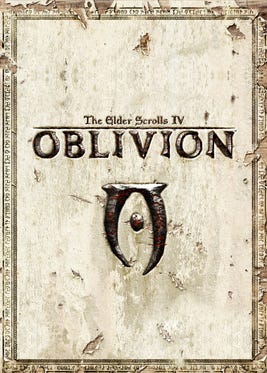
I bought the game and took it home. I stared at the box, avariciously consuming its packaging, its images promising an unknown adventure. I opened the box, popped the CD into my computer, and installed it. At that moment, I learned about hardware limitations. I couldn’t play the game. It was the first major purchase of my youth, and it wasn’t mine to have.
Instead, I went to the house of a friend and installed it on his computer. It ran on lower specs, not that we noticed or cared -- it was the most realistic gaming experienced we had. We played the game, sitting side by side, exploring the fantastical world of Cyrodiil.
I still vividly remember the absolute fright of entering into a dungeon and meeting a hostile wizard. Lightning bolts shot from his hands and quickly depleted our health. We ran to the dungeon door, barely escaping. The both of us exhaled from the intensity of the experience. We were relieved to be safely outside of the dungeon. Then, we saw the wizard fade into the exterior world. These video game characters could move through cells! We could not believe this technology existed! Quickly, one of us jumped onto the keyboard and had our character sprint as far from the dungeon as we possibly could.
Over the years, I had three different friends use my copy of Oblivion before I had my own computer that could run it. When I did, I played that game for hundreds of hours. Soon, I came to join the community of modders who would try to improve the game. I made my own mods and uploaded them online, mostly to silence. Regardless, I became experienced with the internet and computing through the process of making and manipulating mods. It threw me into a digital world I was quick to embrace, for better or for worse.
At that time, Oblivion was all I knew about the Fantasy genre. I had heard people speak about The Hobbit and The Lord of the Rings, but I had neither read the books nor watched the films. With Science Fiction, it was much the same. I had seen one or two of the Star Wars films, but I had otherwise no interest or exposure to the genre in literature or in film.
Despite these omissions of childhood, I loved books, not that I read fiction. I prided myself (erroneously) on reading the non-fiction titles touted by finance and business types. As a Grade 9 student, I was more familiar with Malcolm Gladwell than I was with J. K. Rowling. It would take a long time for my love of fiction to develop, and, even then, only after the long covetous process of seeking to be ‘well-read’.
Certainly, I came across a few books in the twin genres of Science Fiction and Fantasy. I thoroughly enjoyed Emily Rodda’s Deltora Quest and Jonathan Stroud’s The Bartimaeus Sequence, but these seemed to me more like pastimes. I read these books outside of the context of genre. They were simply good books without any relations to other titles.
When the uncertainty of the Covid-19 Pandemic began, I had the privilege of pivoting my work online. Soon, however, I spent too much time on the computer. It became my tool for work, leisure, and social connection. I needed a change. I dusted off a typewriter that had come into my possession and I began to write.
Writing on a typewriter is a different experience from writing on a computer. The typewriter makes you slow down. It makes you think of your words, think of the buttons you are going to press, think about of the space on the page. More than that, every word seemed more permanent, more real. Each press was a definitive clack against the paper, ink not to be undone. I became petrified of using it to write. Perfectionism blocked me. I wanted to be a great writer, and, to my novice mind, that meant that every line had to be gold from the moment it hit the page. Little did I believe in editing or in the total free play of writing. The pen, the typewriter, the keyboard: these were serious tools. I needed to write something different, something distant from the fears of perfection. I wrote about Fallout.
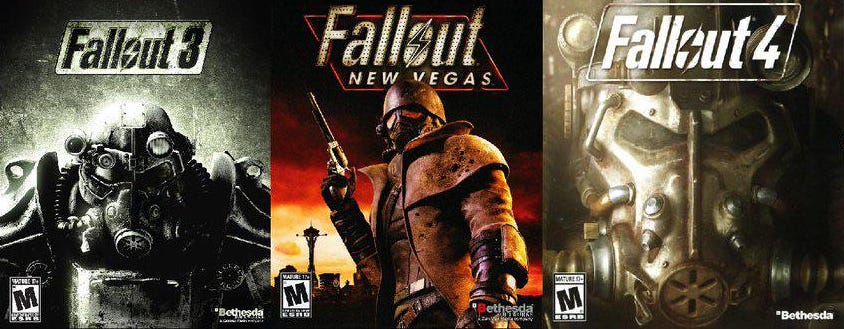
When Fallout 3 launched, I lacked the hardware to run it. Instead, I went to a friend’s house to play it for hours. Likewise, when Fallout: New Vegas launched, I watched another friend play the game. Still, these scant hours had turned to me into a fan of Bethesda games. Eventually, I was able to run New Vegas (and several mods) and became hooked on the title.
Thus, when I tried to write something more fun, more playful, I turned to the world of Fallout. Here, I could write and not worry about world-building, about symbolic themes, about creating something out of nothing. I had everything prepared for me. I only had to hit the keys of my typewriter and create my own escape from the uncertainties of the outside world.
Beyond escapism, this experience allowed me to work on the craft of writing. I began to understand character, narrative, and structure in new ways. I noticed the destructiveness of opulent language and overwrought metaphor. I developed my own style of writing, my own set of rules.
As my time with the typewriter neared its end, more out of frustration with the technology itself, I returned to the computer a more skilled writer. I began to write short stories in the Fallout universe, or, at least, adjacent it, and I posted them online. I expected little, but the little feedback I received excited me. It made me want to continue.
Since then, I have continued to write short stories set in the post-apocalypse. I started a weekly series on RoyalRoad, and I finished my first complete novel during the 2024 April Writathon. I read through more classic titles in the genre of Science Fiction and Fantasy, particularly fiction set in the post-apocalypse.
So, why Science Fiction and Fantasy? For the simple reason that it became a way to write, to learn, and, above all, to have fun.